
Finding the Missing TB Cases: How EPCON’s Model Is Guiding Screening in Uganda
- Jan 14
- 2 min read
Uganda has made real strides against TB. A recent article in The International Journal of Tuberculosis and Lung Disease states that case notifications are up 59% over the past decade, thanks to national awareness campaigns, rapid diagnostics, and community screening by village health teams.
Yet thousands are still missed, partly because risk varies sharply by district. EPCON’s AI-driven model helps Uganda’s National TB & Leprosy Programme (NTLP) and its sub-national and district structures – via the USG-funded Local Partner Health Services - TB Activity implemented by the Infectious Diseases Institute (IDI) – to focus screening on communities predicted to have higher burden, making active case finding more efficient.
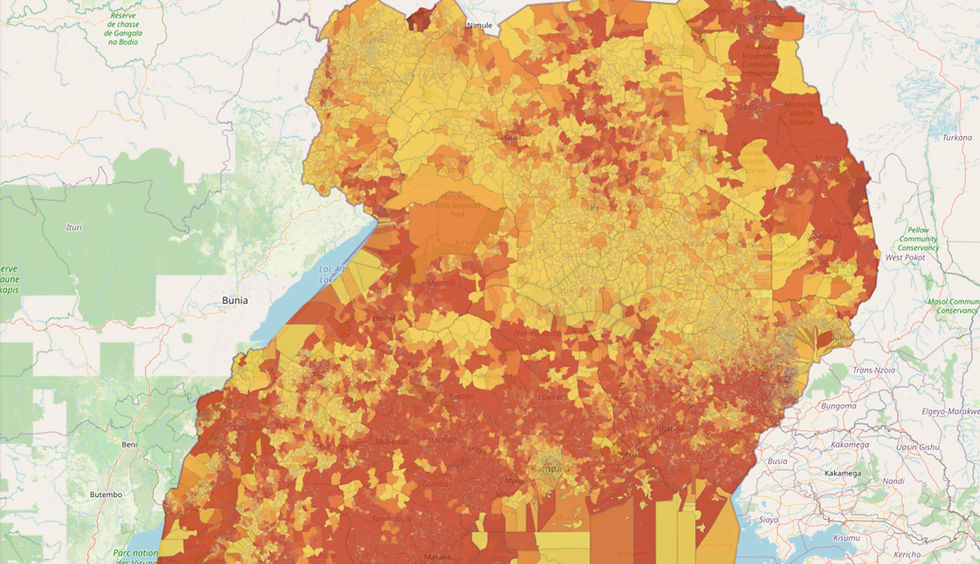
With about 198 TB cases per 100,000 people in 2022, Uganda ranks among the world’s 30 high-burden countries. Despite progress, there’s still a gap between people likely to develop TB and those ultimately recorded by NTLP. Risk isn’t uniform: factors like HIV prevalence can differ four-fold across regions, so national averages hide district-level hotspots. The solution is finer-grained estimates, district by district, and targeted action, which is exactly what EPCON’s AI and data-driven modelling enables.
What EPCON provides
Our Epi-control Platform turns national programme data into district, subcounty, and parish-level hotspot recommendations, each with:
An estimated population and likely TB case count
A priority order for Active Case Finding (ACF) activities
Guidance on assets to deploy (with or without portable X-ray machines)
“Each hotspot comes with actionable figures for district and health facility planning,” says Philip Tumwesigye, Senior Monitoring, Evaluation & Learning (MEL) Advisor at IDI.
Field teams record the cascade:
screened → presumptive → diagnosed → treatment – and results flow back to EPCON, which continuously refines the model.
Gaining efficiency
Hotspots are now identified in every district, so no region is overlooked. The model blends access to health facilities, demographics, past case-finding, precise geolocation, and other indicators, and not poverty alone, to flag where to screen next.
“EPCON’s approach brings communities onto the radar that our routine methods might miss,” says Tumwesigye.
This work supports the UN goal of ending TB by 2030. For this financial year, the near-term aims include 93,000 estimated new and relapsed cases. EPCON helps by enabling:
Higher yield per visit to high-probability communities, accelerating case discovery.
Workflow fit – recommendations span all districts, allowing micro-planning teams to adapt to local staffing and assets.
Continuous learning – feedback from field cascades sharpens hotspot precision over time.
Data realities to manage
The project has delivered strong ACF results, with a few practical challenges:
Upload delays: some community teams postpone reporting while awaiting results – or forget to upload promptly.
Geolocation quality: most entries are accurate, but a minority need coaching due to issues like swapped fields or low-accuracy co-ordinates.
Together with NTLP and IDI, EPCON is turning national data into actionable micro-plans that help Uganda find missed TB cases sooner and more efficiently. For public-sector leaders working at national scale with uneven data and tight budgets, this is a proven, privacy-conscious way to raise yield where it matters most.


